Scarlet: A Dazzling Journey Through the Land of the Dead
- Category: Animation, Action, Drama, Sci-Fi
- Release Date: February 20, 2026 (Turkey)
- Voice Cast: Mana Ashida, Masaki Okada, Koji Yakusho, Yuki Saito, Shota Sometani, Masachika Ichimura
- Language: Japanese (English/Turkish Subtitles Available)
- Duration: 1h 52m
- Director: Mamoru Hosoda
- Screenplay: Mamoru Hosoda
- Studio: Studio Chizu
- Rating: G (General Audiences)
Mamoru Hosoda has long been established as one of the visionary titans of modern anime. With a filmography that boasts emotional powerhouses like Wolf Children, Summer Wars, and the Oscar-nominated Mirai, Hosoda has spent his career exploring the delicate intersection between the digital world, family dynamics, and personal growth. On February 20, 2026, Turkish audiences will witness his most ambitious project to date: Scarlet.
Departing from the cozy rural settings and digital social networks of his previous works, Scarlet plunges headfirst into a high-concept sci-fi fantasy that serves as a loose, futuristic reimagining of Shakespeare’s Hamlet. Starring the voice talents of Mana Ashida and the legendary Koji Yakusho, this film is a visual symphony of color and chaos. It asks profound questions about memory, revenge, and what it means to truly exist. For the anime enthusiasts and cinema lovers on fmovies.tr, Scarlet is not just a movie; it is an event that challenges the boundaries of animation storytelling.
The Plot: To Be or Not To Be in the Void
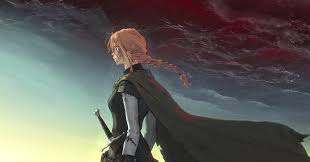
The story introduces us to Princess Scarlet (voiced by Mana Ashida), a fierce but broken young woman consumed by grief. Following the brutal murder of her father, the King, Scarlet attempts to exact revenge on the usurper, Claudius (Koji Yakusho). However, her mission fails catastrophically. Instead of finding justice, she finds death—or something perilously close to it.
Scarlet awakens not in heaven or hell, but in the “Land of the Dead,” a surreal, digital-organic purgatory filled with “madness.” This is not a peaceful afterlife; it is a chaotic realm where souls are constantly in flux, threatened by a terrifying force known as the “Void.” The rules of this world are simple but brutal: if Scarlet cannot achieve her revenge against her nemesis and reach a mythical location known as the “No End Place,” her soul will dissolve into the Void, erasing her existence entirely.
A Race Against Erasure
Guided by a mysterious companion named Hijiri (Masaki Okada)—a reimagining of the loyal Horatio—Scarlet must navigate this treacherous landscape. She encounters twisted versions of figures from her past, including her mother Gertrude (Yuki Saito) and the treacherous duo Rosencrantz (Munetaka Aoki) and Guildenstern (Shota Sometani).
The narrative is a ticking clock thriller wrapped in a metaphysical drama. As Scarlet battles through the Land of the Dead, she is forced to confront the futility of her vengeance. Is the “No End Place” a sanctuary, or is it a trap? And if she destroys Claudius, will it bring her father back, or will it simply complete the cycle of violence that landed her in this purgatory in the first place?
Director’s Vision: Mamoru Hosoda’s Shakespearean Cyberpunk
Mamoru Hosoda is no stranger to reinterpretations of classic tales—Belle was a masterful digital-age update of Beauty and the Beast. With Scarlet, he tackles the heavyweight champion of literature: Hamlet. However, Hosoda filters the Bard’s tragedy through his distinct kaleidoscopic lens.
Visual Aesthetic: The “Land of the Dead” allows Studio Chizu to flex its creative muscles. Unlike the clean, white aesthetic of the internet world ‘U’ in Belle, this world is darker, more psychedelic, and teeming with organic decay mixed with glitch art. The character designs are fluid, with Scarlet’s appearance shifting as her soul wavers between determination and despair. The action sequences are fluid and balletic, utilizing 3D CG to create massive, impossible architectures that Scarlet must traverse.
Thematic Depth: Hosoda uses the sci-fi setting to externalize Scarlet’s internal mental state. The “madness” of the world is a reflection of the protagonist’s grief. By gender-swapping the lead (Hamlet becomes Scarlet), Hosoda brings a different emotional vulnerability to the role. It isn’t just about a prince’s duty; it’s about a daughter’s loss. The director focuses heavily on the concept of “legacy”—if we die, do we only exist as long as someone remembers us?
The Cast: A Voice Acting Tour de Force
The emotional weight of Scarlet rests on its vocal performances, and the cast list reads like a who’s who of Japanese talent.
- Mana Ashida as Scarlet: A former child prodigy turned powerhouse actress, Ashida brings a incredible range to Scarlet. She captures the character’s rage in the battle scenes but also the quiet, trembling fear of being forgotten. Her voice cracks with an authenticity that grounds the fantastical elements.
- Koji Yakusho as Claudius: Fresh off his international acclaim for Perfect Days, Yakusho lends his deep, gravelly baritone to the villain. He plays Claudius not as a cackling antagonist, but as a weary, philosophical figure who believes his treachery was necessary. He is terrifying because he sounds so reasonable.
- Masaki Okada as Hijiri: Okada provides the calm in the storm. As the Horatio figure, he grounds Scarlet, and his gentle performance provides the film’s emotional anchor.
- The Supporting Ensemble: Shota Sometani and Munetaka Aoki steal scenes as the bumbling, slightly digitalized Rosencrantz and Guildenstern, providing much-needed comic relief in a dark story. Yutaka Matsushige as Cornelius adds a layer of bureaucratic absurdity to the afterlife politics.
Critical Review: An Anime Epic for the Ages
Scarlet is arguably Mamoru Hosoda’s most mature film. While it retains the “G” rating and is accessible to families, the themes are dense and philosophical.
Animation and Sound
Studio Chizu has outdone itself. The contrast between the stark, grey reality of the opening scenes and the exploding neon colors of the Land of the Dead is breathtaking. The “Void” is depicted with a terrifying minimalism—a white static that eats away at the edges of the frame. The score, likely an orchestral arrangement mixed with electronic synths, underscores the collision of the old world (Hamlet) and the new (Sci-Fi).
Reimagining Hamlet
Purists might balk at the liberties taken with Shakespeare’s text, but Scarlet captures the spirit of the play perfectly. It explores the paralysis of indecision and the poison of revenge. However, Hosoda offers a glimmer of hope that the original tragedy lacked. Without spoiling the ending, the journey to the “No End Place” suggests that redemption is possible, even after death.
Pacing
If there is a critique, it is that the middle act, where Scarlet navigates the various trials of the afterlife, feels slightly episodic. The urgency of the “Void” sometimes takes a backseat to world-building. However, the emotional payoff in the final confrontation with Claudius is worth every minute of the buildup.
Scarlet is a dazzling, heartbreaking, and visually stunning achievement. It cements Mamoru Hosoda’s status as a director who refuses to be pigeonholed.
By combining high-octane action with the melancholy of Shakespeare, he has created a film that is unique in the anime landscape. Mana Ashida’s performance is award-worthy, breathing life into a character fighting against her own erasure. For fans of Spirited Away or Paprika, this is a journey into the afterlife you cannot miss. It is a reminder that even in a world filled with madness, love is the one thing that never becomes void.