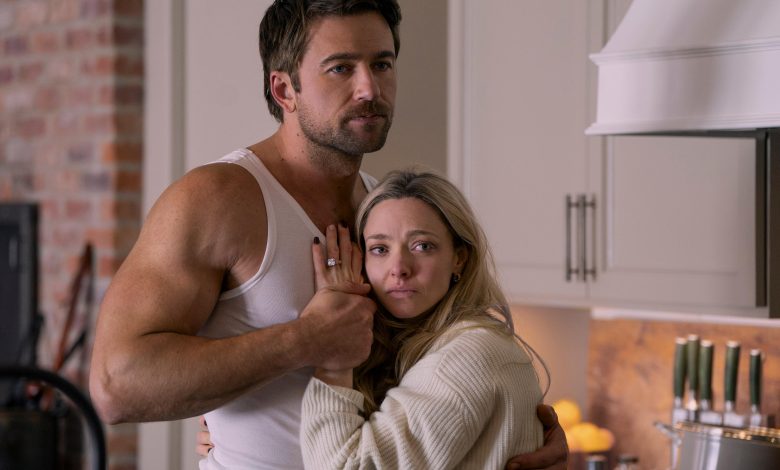
The Housemaid (Hizmetçi): A Glossy, Twisted Game of Cat and Mouse Behind Closed Doors
- Category: Psychological Thriller, Mystery, Drama
- Release Date: 2025 (In Theaters)
- Cast: Sydney Sweeney, Amanda Seyfried, Brandon Sklenar, Michele Morrone, Elizabeth Perkins
- Language: English (Turkish Subtitles Available)
- Duration: 2h 11m
- Director: Paul Feig
- Writers: Rebecca Sonnenshine, Freida McFadden (Novel)
If you have walked into a bookstore or scrolled through “BookTok” in the last two years, you have undoubtedly seen the cover of Freida McFadden’s The Housemaid. It is a literary phenomenon, a gripping page-turner that revitalized the domestic thriller genre. Now, in 2025, the highly anticipated film adaptation has arrived, bringing the claustrophobic terror of the Winchester household to the big screen.
Directed by Paul Feig—a filmmaker who pivoted brilliantly from comedy to stylish noir with A Simple Favor—this adaptation of The Housemaid (known in Turkey as Hizmetçi) is a slick, tension-filled ride. Featuring a powerhouse duel between two of Hollywood’s most captivating actresses, Sydney Sweeney and Amanda Seyfried, the film transforms a story about dirty laundry and scrubbing floors into a lethal battle for survival. For the audience on fmovies.tr who crave plot twists that snap like a mousetrap, this is the definitive psychological thriller of the year.
The Plot: A Fresh Start with a Dark Price
The story follows Millie Calloway (Sydney Sweeney), a young woman living on the edge. She is practically homeless, sleeping in her car, and desperate for a job. But Millie has a secret—a past she is running from, and a criminal record that makes finding employment nearly impossible. When she lands an interview for a live-in housekeeping job at the luxurious home of the Winchester family, it feels like a miracle.
The job seems perfect on paper: good pay, a beautiful Long Island mansion, and a place to sleep. However, the “place to sleep” turns out to be a tiny attic room with a window that barely opens and a lock on the outside of the door.
The Perfect Family?
Millie’s employer, Nina Winchester (Amanda Seyfried), is an enigma. One moment she is the picture of elegance; the next, she is manic, cruel, and intentionally messy, forcing Millie to re-clean rooms she just scrubbed. Nina’s behavior is erratic and abusive, pushing Millie to her breaking point.
Conversely, Nina’s husband, Andrew Winchester (Brandon Sklenar), seems to be the only source of sanity. Handsome, wealthy, and seemingly trapped in a marriage with an unstable woman, Andrew shows kindness to Millie. A dangerous dynamic begins to form: the suffering maid, the “crazy” wife, and the suffering husband. But in a Freida McFadden story, nothing is ever what it seems. As Millie digs deeper into the family’s history, she discovers that the Winchesters’ closet is full of skeletons—and she might be the next one if she isn’t careful.
Director’s Vision: Paul Feig’s Domestic Noir
Paul Feig is an interesting choice for this material, but he proves to be the right one. He understands that domestic thrillers are inherently campy. They rely on melodrama, high fashion, and sharp dialogue. Feig embraces the glossiness of the setting. The Winchester house is shot like a museum—cold, sterile, and imposing.
Atmosphere of Dread: Feig uses the architecture of the house to build tension. The contrast between the bright, airy living spaces and the dark, cramped attic where Millie lives emphasizes the class disparity and her imprisonment. The sound design is subtle but effective—the creak of a floorboard, the locking of a door, the hum of the refrigerator—amplifying Millie’s isolation.
Visual Storytelling: Feig focuses heavily on appearances. Nina is always dressed in immaculate, expensive clothing, contrasting with Millie’s worn-out uniform. This visual language highlights the power imbalance. The camera often lingers on mirrors and reflections, hinting at the duality of the characters and the idea that everyone is wearing a mask.
The Cast: A Masterclass in Manipulation
The film’s success hinges entirely on the chemistry—and animosity—between its leads.
- Sydney Sweeney as Millie: Sweeney (Euphoria, Reality) is perfect for the role of Millie. She excels at playing characters who are underestimated. Millie is scrappy and desperate, but she is not weak. Sweeney conveys a simmering rage beneath her polite “Yes, ma’am” exterior. As the film progresses and the danger escalates, Sweeney transforms from a victim into a fighter. It is a physical, gritty performance.
- Amanda Seyfried as Nina: Seyfried steals every scene she is in. Playing the “unhinged wife” is a trope, but Seyfried gives it layers. She is terrifying one minute and heartbreakingly fragile the next. Is she truly mentally ill, or is she playing a game? Seyfried keeps the audience guessing with her wide-eyed, frantic delivery. Her ability to switch emotions on a dime makes Nina a truly formidable antagonist.
- Brandon Sklenar as Andrew: Sklenar (1923, It Ends with Us) has the difficult task of playing the “perfect man” who is too good to be true. He brings a charm that borders on predatory. His chemistry with Sweeney is palpable, driving the forbidden romance subplot that complicates the narrative.
- Michele Morrone as Enzo: The inclusion of Morrone adds a wild card element to the neighborhood dynamics, providing clues to the mystery from the outside looking in.
Critical Review: Does It Do the Book Justice?
Adapting a book with a twist as famous as The Housemaid is a challenge. The screenplay by Rebecca Sonnenshine stays faithful to the core beats of the novel while expanding on the visual horror elements.
The Pacing and The Twist
The film is split into distinct acts. The first half is a slow-burn study of workplace abuse and gaslighting. It makes you feel Millie’s exhaustion. The second half, however, shifts gears rapidly. Without spoiling the iconic twist, the movie handles the perspective shift masterfully. Paul Feig uses visual cues to recontextualize scenes we saw earlier, revealing the truth hidden in plain sight.
Themes of Power and Control
At its heart, The Housemaid is a story about women navigating a world controlled by men and money. It explores how abuse can be disguised as privilege. Nina seemingly has everything, yet appears miserable. Millie has nothing, yet possesses a freedom Nina envies. The film critiques the idea of the “perfect marriage” and exposes the violence that can happen behind the closed doors of suburbia.
Comparisons
It evokes the same feelings as Gone Girl or The Girl on the Train, but with a more blue-collar protagonist. Unlike those films, which focus on wealthy women, this is the story of the help—the invisible person in the room who sees everything.
The Housemaid is a deliciously dark, entertaining, and stressful watch. It is pop-corn cinema with a sharp edge. Sydney Sweeney and Amanda Seyfried deliver electric performances that elevate the material from a standard paperback thriller to a cinematic event.
If you have read the book, you will appreciate seeing the Winchester house brought to life. If you haven’t read the book, prepare to have the rug pulled out from under you. It is a reminder that you should always be careful who you invite into your home—and who you lock in your attic.