Dead Eyes: When Grief Becomes a Bridge to the Other Side
- Category: Horror, Thriller, Found Footage / POV
- Release Date: February 2026 (Limited Theatrical & VOD)
- Cast: Rijen Laine, Ana Thu Nguyen, Charles Cottier, Alea O’Shea, Mischa Heywood, Stephen Phillips, Freya Callaghan
- Language: English
- Duration: Approx. 1h 35m
- Director: Richard E. Williams
- Screenwriter: Richard E. Williams
- Producer: Richard E. Williams
- Studio: Independent
- Rating: Not Rated (Contains intense terror, violence, and strong language)
The horror genre has always been obsessed with perspective. From the voyeuristic lens of the slasher to the shaky-cam realism of found footage, how we see the scare is just as important as the scare itself. In 2026, director Richard E. Williams takes this obsession to its logical, terrifying extreme with Dead Eyes.
Marketed as a “first-person nightmare,” Dead Eyes is not merely a movie you watch; it is a movie you inhabit. By locking the camera’s eye to the protagonist’s perspective, Williams forces the audience to become the victim. We cannot look away when the shadows move. We cannot close our eyes when the dead appear. Starring a committed ensemble cast led by Rijen Laine and Ana Thu Nguyen, this film is a grueling, visceral exploration of how grief can open doors that should remain shut. For the horror aficionados on fmovies.tr who crave an immersive experience akin to Hardcore Henry meets The Blair Witch Project, this is the most unsettling release of the year.
The Plot: A Search Party for the Damned
The narrative is deceptively simple, grounding its supernatural terrors in a very human tragedy. The story centers on Sean (Rijen Laine), a young man whose life has been fractured by loss. The recent, traumatic death of his sister has left a void in his family, a void that his father attempted to fill by vanishing into the wilderness.
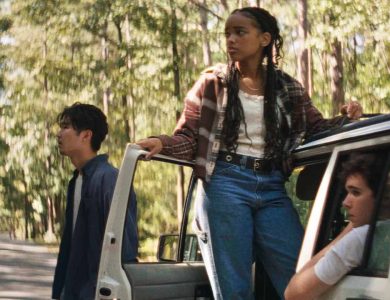
Desperate for closure and fearing the worst, Sean rallies a group of friends—including characters played by Ana Thu Nguyen, Charles Cottier, and Alea O’Shea—to venture into a remote, sprawling forest to find his missing father. The setting is classic horror fodder: dense trees that block out the sun, silence that feels heavy, and a sense of isolation that grows with every step.
The Bridge Between Worlds
What begins as a rescue mission quickly deteriorates into a psychological ordeal. As the group delves deeper into the woods, they discover that Sean’s father wasn’t just lost; he was searching for something. Or someone. The forest is not empty. It is a liminal space where “grief has become a bridge between the living and the dead.”
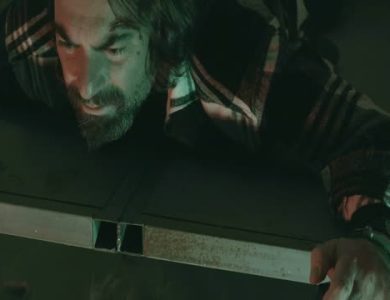
The “first-person” aspect becomes crucial here. We see what Sean sees. We experience his hallucinations—or are they?—of his dead sister. We find the disturbing artifacts left behind by his father, hinting at dark secrets and occult rituals meant to cheat death. As the sun sets and the flashlights flicker, the group realizes they are being hunted not by a wild animal, but by the very grief they are trying to outrun. The forest begins to warp, time loses its meaning, and the line between the friends’ sanity and the supernatural reality blurs into a bloody mess.
Director’s Vision: Richard E. Williams’ Immersive Terror
Richard E. Williams has taken a bold risk with the format of Dead Eyes. First-person POV is notoriously difficult to pull off without causing motion sickness or feeling like a video game gimmick. However, Williams uses it to enhance the claustrophobia.
The POV Technique: Unlike traditional found footage, which justifies the camera as a physical object (a camcorder, a phone), Dead Eyes adopts a more cinematic POV style. The camera is Sean’s eyes. When he blinks, the screen cuts to black for a split second. When his heart races, the camera mimics the frantic movement of a panicked head. This creates an unparalleled level of immersion. When a character screams “Look out!”, the camera whips around, and the audience feels the whiplash.
Visual Atmosphere: The forest is shot with a desaturated, cold palette. Williams plays with peripheral vision masterfully. Often, the scare isn’t in the center of the frame; it’s a figure standing just on the edge of Sean’s vision, barely noticeable until it’s too late. This forces the audience to scan the screen constantly, creating a state of high anxiety. The lighting—limited to flashlights and the dying light of day—creates deep pockets of shadow where the imagination runs wild.
The Cast: Acting Through the Lens
In a POV film, the lead actor (Rijen Laine) faces a unique challenge: he is mostly heard, not seen, yet he must carry the emotional weight of the film. The supporting cast, conversely, must react to the camera as if it were a person, requiring a level of naturalism that is hard to fake.
- Rijen Laine as Sean: Laine’s voice acting is the anchor of the film. We hear his breathing shift from steady to ragged; we hear the cracks in his voice as he calls out for his father. Through his physical performance (we see his hands, his feet, his reflection), he conveys a desperation that is palpable. He effectively portrays a man slowly losing his mind to grief.
- Ana Thu Nguyen: As one of the primary supporting characters, Nguyen does the heavy lifting on screen. She acts as the audience’s emotional gauge. When she looks into the camera (at Sean) with fear, we feel afraid. She brings a fierce loyalty to the role, trying to keep Sean grounded even as the supernatural events escalate.
- Charles Cottier and Alea O’Shea: The supporting friends provide the necessary skepticism. Cottier, known for his work in Australian television, brings a grounded charisma that slowly erodes into terror. Their interactions feel like genuine friendship, which makes their inevitable separation in the dark woods all the more tragic.
- The Ensemble: Mischa Heywood, Stephen Phillips, and Freya Callaghan round out the cast, likely playing the roles of the missing father or the spectral figures that haunt the woods. Their physical performances—often seen in glimpses or distorted by shadows—are terrifying.
Critical Review: A Visceral Study of Loss
Dead Eyes is not for the faint of heart. It is an intense, grueling experience that prioritizes dread over jump scares, though it has plenty of those too.
Themes of Grief
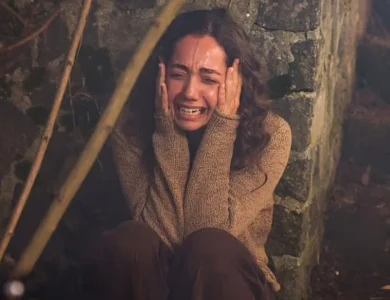
At its core, this is a film about the inability to let go. The central metaphor—that grief acts as a bridge to the dead—is explored literally. Sean’s refusal to accept his sister’s death is what powers the horror. The film suggests that mourning is a dangerous process; if you stare too long into the abyss of loss, something might stare back. It joins the ranks of films like The Ritual and Hereditary in using horror to explore family trauma.
The Effectiveness of the Gimmick
Does the first-person perspective work? For the most part, yes. There are moments where the camera movement might be disorienting for some viewers, but it serves the story. It limits our information. We only know what Sean knows. We cannot see what is behind him. This limitation builds suspense effectively. The sound design does a lot of the work here—twigs snapping behind the camera, whispers in the left ear—creating a 360-degree soundscape that complements the visual tunnel vision.
Pacing and Scares
The film starts as a slow-burn mystery, focusing on the investigation into the father’s disappearance. However, the third act is a relentless descent into madness. Once night falls, the pacing accelerates. The encounters with the entities are shocking and visceral. Williams avoids CGI for the most part, relying on practical makeup and lighting effects to create the “dead,” which gives them a tactile, rotting quality that is deeply disturbing.
Dead Eyes is a bold experiment that pays off. It revitalizes the found footage/POV sub-genre by injecting it with high-stakes emotional drama and polished cinematography.
Richard E. Williams has crafted a film that feels personal and dangerous. Rijen Laine and Ana Thu Nguyen deliver performances that ground the supernatural in human reality. If you are looking for a horror movie that will make you afraid to walk past a mirror or step into the woods, Dead Eyes is essential viewing. Just remember: in this film, you are the one being hunted.